
Santa Barbara Directory Landscape
Santa Barbara people directories are split among city offices, county departments, schools, colleges, record custodians, professional boards, and heritage collections. Each list answers a different question. The city list identifies officials and department leaders. Education pages locate public-facing school and campus contacts. The recorder index connects names with filed documents, while the assessor begins with an address or parcel rather than a person's name. Historical collections extend the search to past residents, families, and local groups.
| Local directory | People or entries included | Keeper | How to use it |
|---|---|---|---|
| City Directory | Officials, councilmembers, directors | City of Santa Barbara | Public web browse |
| County Directory | Departments and elected offices | Santa Barbara County | Public web browse |
| SBCEO Staff Profile | County education staff | County Education Office | Keyword or name search |
| UCSB Directory | Faculty and staff | UC Santa Barbara | Public search with use limits |
| Official Records Search | Parties to recorded documents | County Clerk-Recorder | Name and date search |
| Sahyun Library directories | Past residents and businesses | County Genealogical Society | Library shelves and digitized items |
Start with the list tied to the person's role. For a principal, use a school contact directory. For a past occupant, consult the city-directory run and local history sources. A deed party belongs in the recorder index. That source-by-role approach avoids treating a staff roster or parcel tool as a broad resident list.
Santa Barbara Education Directory Search
Education directories form a strong local group. The Santa Barbara County Education Office Staff Profile has three direct search fields. Santa Barbara Unified contacts list schools, phone numbers, principals, and principal email addresses. The Santa Barbara City College directory starts with departments, while faculty and program pages can add individual names, roles, email addresses, extensions, and offices.
| SBCEO field | Input type | Required | Search behavior |
|---|---|---|---|
| Keyword | Text | No | Searches staff profile text |
| First Name | Text | No | Filters by first name |
| Last Name | Text | No | Filters by last name |
| Staff profile result | Entry | Not applicable | Opens the matching contact profile |
The SBCEO staff search shows how these Santa Barbara people directories narrow a name without asking for private personal details.
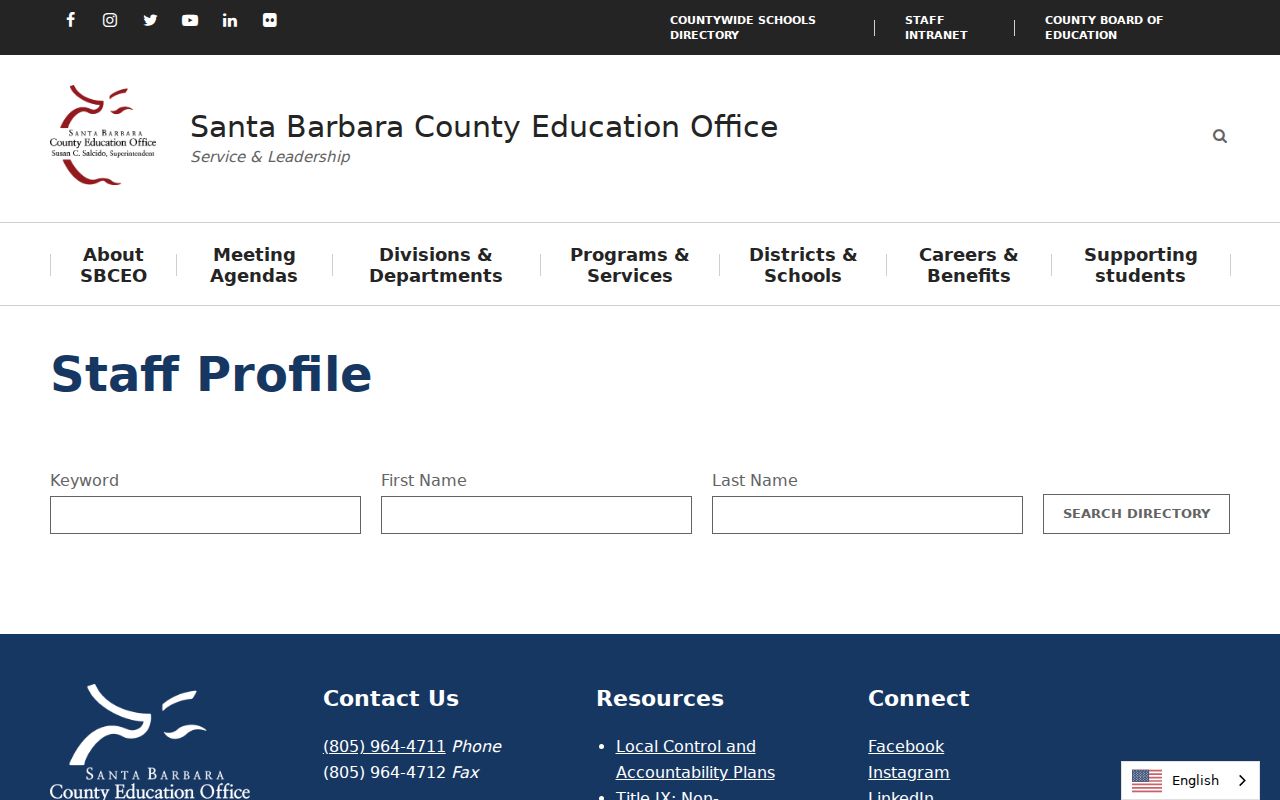
The separate keyword, first-name, and last-name boxes make this directory most useful when only part of an educator's name or role is known.
Browsing Santa Barbara Government Directories
The City of Santa Barbara directory is a browseable leadership roster, not a private-resident search. It names councilmembers by district and senior staff such as department directors, the city attorney, police chief, and assistant city administrator. A role can therefore lead to the person responsible for a city service. The Santa Barbara County directory takes a department-first approach, with entries for the Board of Supervisors, Clerk/Recorder/Assessor/Elections, County Counsel, and other offices.
Neither list was verified as a complete employee phone book. No specific statewide employee directory was fully inspected either, so it should not be presented as an established search here. When a name is absent, browse to the relevant department, call its main contact, or ask the agency for the correct public contact. Questions about records access and custodians belong in the Santa Barbara public records reference.
Note: Government directories identify officials and public contacts; they should not be read as complete lists of everyone who works for an agency.
Santa Barbara Directory Entry Details
A directory result has value only when its fields fit the task. UCSB unit pages and local education staff pages commonly publish professional contact details. The campus-wide UCSB directory covers faculty and staff, while its student search requires a campus login. An office or department page may fill a gap when a campus-wide result is sparse.
- Name: identifies the faculty or staff member.
- Title or role: separates similar names and explains responsibility.
- Department or unit: places the person within the campus or education office.
- Email address: supplies a public professional contact when displayed.
- Phone number: may be a direct line, extension, or unit contact.
- Photo or office grouping: appears on some unit pages, but not every entry.
Use the role and unit together before assuming that two similar names refer to one person. A department listing can also be more current than an old document copied elsewhere.
Santa Barbara Records as Directories
Some public indexes work like people directories even though that is not their formal purpose. The Clerk-Recorder Official Records Search is name-first. It links people and organizations to recording dates, document types, document numbers, and map book or page references. Its name screen reports an index from January 1, 1900 through the current update, while the county describes a post-1975 real-estate index and a separate 1931-1974 historical index. Older books remain with Historical Archives.
The Assessor Parcel Details lookup works in the opposite direction. The inspected form searches by parcel number or street address, not by owner name. It returns parcel, assessed-value, and map details. In plain terms, a parcel is the county's unit of land for assessment. The assessor can turn an address into a parcel number, while recorded documents can tie a name to a deed or lien.
City directories at Sahyun Library add a third route: an old name may lead to an address, and a reverse or criss-cross directory may lead from an address to an occupant.
Professional Directories Serving Santa Barbara
California's verified professional and business systems can confirm a public role, license status, or business link in Santa Barbara. The Secretary of State business search covers corporations, limited liability companies, and limited partnerships. Results may include an entity number, status, formation date, agent for service of process, office addresses, and filed documents. The related UCC search contains abstracts for lien notices.
The Department of Consumer Affairs license search spans many regulated occupations and can show a name, license number, status, city, and public discipline data. The State Bar Attorney Search uses attorney names or bar numbers and may show status, admission, and discipline or administrative history. Its extended-character limitation makes variant spelling important, including searching an unaccented form when an accented surname returns nothing.
No searchable Santa Barbara city business-license register or inspected chamber member directory was confirmed during source review. Those sources are therefore not treated as proven people directories. Official state filings and board records are the sound fallback.
Santa Barbara Directory Privacy Limits
Directory access does not grant unlimited reuse. UCSB states that its directory is campus property and restricts commercial use, rental, distribution, sale, and use for mailings under the California Information Practices Act. Student search is login-only. The voter file is even more limited: Santa Barbara County makes voter data available only for election, scholarly, journalistic, political, or governmental purposes as determined by the elections official. It is not a casual address book.
Public web forms can also omit fields by design. The county assessor's public form has no owner-name input. Government rosters emphasize public roles, and education pages publish professional contacts rather than personal profiles. Respect those boundaries. Never use directory information to stalk, harass, threaten, or evade a confidentiality measure.
Historical Santa Barbara People Directories
The Santa Barbara County Genealogical Society gives the city a well-defined directory trail. Its Sahyun Genealogical Library collection includes printed directories from 1886 through 1991 for Santa Barbara and other county cities, including Santa Maria and Lompoc. The Society also lists a digitized Great Register from 1877 and a digitized Santa Barbara City Directory from 1886. These sources can place a resident or business at an address long before current web listings.
- Great Register
- A historical voter register that can identify eligible voters in a place and time.
- City directory
- A periodic name and address list that may also include occupations and businesses.
- Reverse directory
- A criss-cross list arranged by street address, useful for finding a past occupant.
- Yearbook
- A school publication that can connect names with classes, groups, staff, and activities.
The shelf run spans more than a century, but digitization is not complete. Contact the Society or use Sahyun Library for years that are not online. Santa Barbara Public Library can also route obituary and local-history requests, including mailed requests to its Reference Unit.
Santa Barbara Directory History Ladder
Santa Barbara's named sources reach well before the modern city-directory era. The sequence helps select the right keeper instead of forcing every person into a current portal.
| Period | Directory or name source | Local access point |
|---|---|---|
| 1769-1850 | Mission-era population records | Mission Archive-Library and Early California Population Project |
| 1850 forward | County land, vital, map, and court records | Clerk-Recorder archives and Superior Court |
| 1852 forward | Naturalization petitions and related papers | Genealogical Society indexing project |
| 1877 | Santa Barbara Great Register | Digitized Society material |
| 1886-1991 | Printed city directories | Sahyun Genealogical Library |
| 1900 forward | Recorder name index | Official Records Search, with coverage caveats |
The Santa Barbara Mission Archive-Library genealogy resource points to population data from the Spanish and Mexican mission era. County civil recordkeeping begins around statehood. This shift from church and mission sources to county files explains why one family may require several directory systems.
Santa Barbara Directory Fallbacks
When an online directory ends, local collections keep the trail moving. The Genealogical Society indexes Santa Barbara County Superior Court naturalization records from 1852 forward. Those files may include a petition and oath, certificate of arrival, witness depositions, and declaration of intention. The Society states that the originals are not at the National Archives, and indexing is still underway. For an immigrant ancestor, a local request can succeed where a national search does not.
The Santa Barbara Public Library local history service accepts obituary and history requests and points to the Society's updated obituary database. UCSB Special Research Collections preserves more than one hundred named local-history collections about individuals, families, organizations, planning, architecture, and community events. Its material is non-circulating and uses a reading-room appointment process.
Use the phone, mail, library shelf, archive, or reading room when the web entry is missing. Chamber lists, cemetery databases, congregation archives, funeral-home indexes, and alumni directories were not fully verified, so none should be assumed to exist or have broad access. A clearly documented gap is more useful than an unsupported directory claim.